Showing posts with label folk art. Show all posts

Tuesday, February 5, 2013

Aurie Ramirez

Inspired by this great article on outsider artists, I decided to do a post on Aurie Ramirez. Inspired by the Addams Family and the Band Kiss, Ramirez takes her influences of punk rock, 18th century dandyism, neo-Victorian decorum, and psychedelia and rehashes them into colorful, vibrant pieces. 


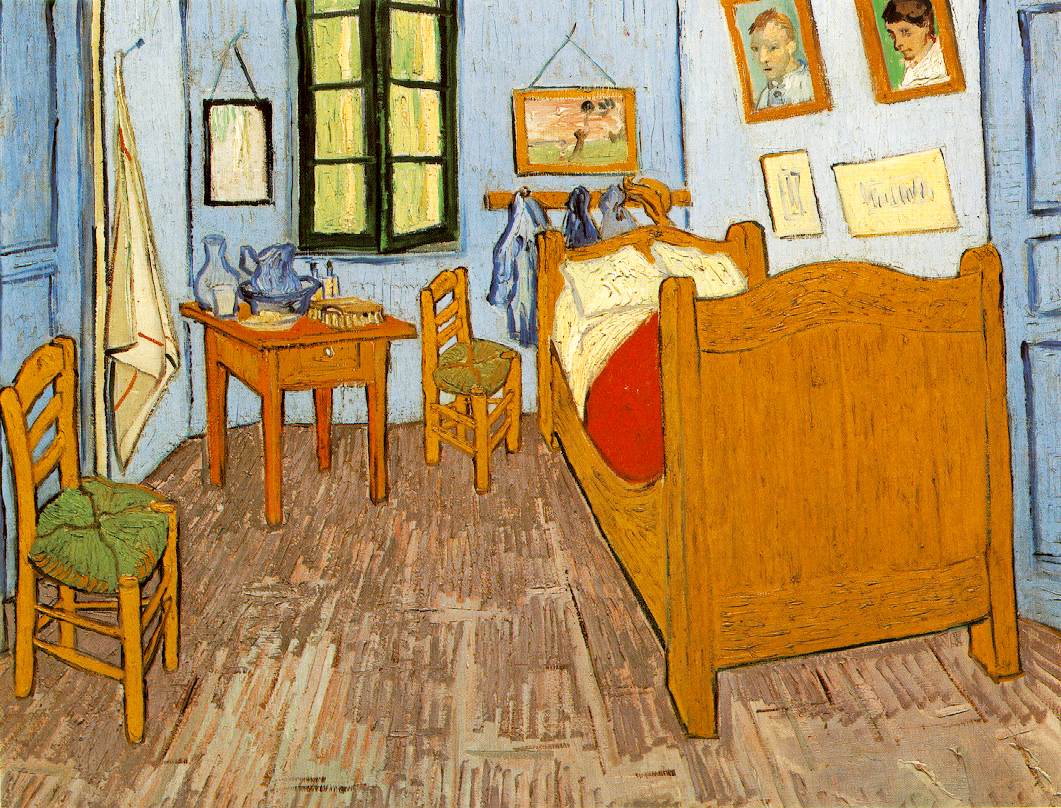
The wiggling lines in this remind me of the energy of van Gogh's paintings... Although her lines are definitely more deliberate, I think they both convey the feeling of movement, a flux that is communicated not only through the variegated lines, but also the diverse hues of color. 


I think a very big difference between these paintings is depth. With a lot of folk artists, you'll see a lack of perspective and everything is very 2-D and flat. With van Gogh's room, we have the angle of the bed and the chair to give us a feeling of roominess. It must be pointed out that although Ramirez's piece above is arguably flatter than van Gogh's painting, she does have the bedside table and the slight angle of the bed frame that let us know there is a level of sophistication to her work that shouldn't be dismissed. Also, if you're itching to know more about van Gogh... check out this amazing video on van Gogh! 

Back to Aurie!


Ah! Isn't this so great? I love the contrast between the woman and the outlet. It's the scale that makes this piece so interesting to me. A little more on Ramirez: She was born in 1962 in the Philippines. In a press release from a gallery, it was said that  “Aurie has a condition that shares many characteristics with autism. Notably, she both speaks and writes in a language of her own devising.” According to this very thorough biography of her: Matthew Higgs, who guest-curated the show at the Jack Hanley Gallery, has been careful not to present the work of Aurie Ramirez as a species of outsider or self-taught art. Indeed, such terms would not accurately describe Ramirez’s history or practice. Ramirez is one of many artists associated with an Oakland institution called Creative Growth Art Center whose stated mission is to serve “physically, mentally, and developmentally disabled adult artists, providing a stimulating environment for artistic instruction, gallery promotion and personal expression.” 


So, she's not exactly a "folk" artist. I think I would more define her as an intuitive artist. The tricky thing about folk art is that it is extremely difficult to define. But that's a whole different post.

I hope you enjoyed Aurie Ramirez as much as I did! 

Wednesday, January 30, 2013

Adventures in Art - Intuit


This past weekend I went to Intuit, which is a museum for outsider and intuitive art. They have a Henry Darger installation that I've wanted to see for a while now and I finally got to experience it. 


I have to say, I was a little disappointed that there wasn't more of his art displayed, but the room was fantastic. I think I'll have to revisit the documentary again because I was so excited! They were able to make an approximate recreation of his apartment, at least in size. If the installation was true to life, he did not have very much space. The above picture is probably 1/4 of the whole room. The other exhibitions were wonderful and interesting. I highly recommend visiting Intuit.

I also visited the Roger Brown Study Collection and I'm going to do a separate post about that... but here's a sneak peek!


Tuesday, January 29, 2013

Artist Spotlight - Levi Fisher Ames

I love small things. I love things displayed in boxes. 
As a result, I love Levi Fisher Ames' menagerie of carved animals.

Ames was born in 1840 in Pennsylvania and moved to Green County, WI while young. In 1862, he joined the Union Army's Thirty-seventh Regiment of Illinois Volunteers. He was wounded, discharged and rejoined three months later. His records indicate that he was hospitalized for much of his three-year enlistment. Afterwards, he moved to Monroe, WI where he lived for the rest of his life. 

Although he was a carpenter before the war, he honed his whittling skills while hospitalized and continued to work as a carpenter and artist after the war. 

This is where things get interesting, in my opinion.

So Levi Fisher Ames carves and carves and has all these creatures and makes all these boxes for them and then makes bigger boxes for the little boxes and then he travels around Barnum and Bailey style and calls it a museum and charges 10 cents for people to look at it... and it worked! People paid! 

Something that I think is pretty remarkable is that the pieces within have never been separated. Ames felt that it was a set and refused to sell off creatures from it. Eventually, Ames died and his sons inherited the menagerie. During the Depression, they sold the whole thing to a pawn shop. However, they were able to get the whole museum back intact a few years later. Now John Michael Kohler Arts Center is taking care of the zoo and it will surely not be separated then. 

Here's a book, if you wish to learn more! 
http://www.jmkacstore.org/levifisheramesmenagerie.aspx


Artist Spotlight: Mary Nohl

The Fox Point Witch!

Just down the road from my university, down a curving hill and past the blue waters of Lake Michigan lies the Mary Nohl Art Environment. (Also known as The Fox Point Witch's House and the Mary Nohl House) 


Born in 1914, Mary Nohl graduated from the Art Institute of Chicago and taught in junior high schools around the area and eventually opened her own ceramics studio for 10 years. 
After her parents died, Mary Nohl received an inheritance which allowed her to create a massive collection of folk art, including statues and architectural features. After Mary Nohl's death, the Kohler foundation acquired the property and began cataloging the hundreds of pieces that she had made from 1961-2001, the year of her death. Although she donated many of her pieces to the John Michael Kohler Arts Center when she was alive, they've also acquired her house after her death and are working hard to preserve and conserve it (as well as make it available to the public - fingers crossed!)

The whimsy of the home jumps out at you when you drive by. The house has bright, wooden reliefs of blue, turquoise and red.  The house is surrounded by concrete sculptures with different natural elements mixed in- like driftwood, rocks from the beach and glass. She drew much of her inspiration from the lake right outside her house. One of the things I admire about Mary Nohl is her perspective that everything could be a medium. She transformed everything from her lawn to the inside of her house; making it go from drab to expressive. The house is a private residence and the other people in the neighborhood don't really like having people hanging out and looking at the house. That's why it isn't open to the public, unfortunately. 

Although she is most known for her concrete sculptures outside fo her home, she also worked with...

Wood
She carved faces out of wood and made them into a playful fence. She eventually hung the wooden faces from the trees surrounding her yard, because vandals were stealing them.


Metal
She created jewelry! Often depicting people in boats, likely inspired by her home on the lake. You can actually still buy her designs at the John Michael Kohler Arts Center store page.


Woodcut & Printing
In the book Mary Nohl: Inside and Out, there are many pictures of her woodcuts. I was unable to find any pictures online, unfortunately. They are of people and rooms and streets, likely to be Maryland; where she was an art teacher at the time. If you look at Van Gogh's bedroom painting, they look a little like that. With wiggly, expressive lines and energy bouncing from the images. 

Ceramic
After she traveled and taught, she became a potter and opened her own studio and sold her own designs. You can see the clear beginnings of her whimsical style that would later define her concrete works: curious faces and expressive bodies.

This is an intern for the Kohler Foundation making an inventory of some of the ceramic items in Mary's home after her death. 

Mary Nohl also painted, drew and experimented with all sorts of mediums in between. She truly is an inspiration to artists who want to try everything. There is much more that I can say about Mary, but instead I will end with a quote from her:

"No amount of disorder will induce me to give up my front row seat on the changing moods of Lake Michigan- the ice hills against the blue water in the winter, and the afterglow of the sunsets in the summer, and the infinite variety in between."

Sunday, January 6, 2013

Artist Spotlight: Henry Darger


One of my favorite folk artists is Henry Darger. I think he embodies the great mystery that is folk art and self-taught artists. A virtual unknown, overlooked for most of his life, Henry Darger has become known for his 15,145-page, single-spaced fantasy manuscript called The Story of the Vivian Girls, in What is known as the Realms of the Unreal, of the Glandeco-Angelinian War Storm, Caused by the Child Slave Rebellion. With the manuscript are several hundred accompanying pictures, done in watercolors and created over six decades, most of which were discovered posthumously. 

Born in 1882, Darger had a less than ideal childhood. His mother died when he was four and his father when he was 13, after which he was institutionalized in the Illinois Asylum for Feeble-Minded Children in Lincoln, Illinois. He eventually ran away from the institution, walking over 100 miles back to Chicago where his godmother helped him find a job. By this time, he was 16. The job he got was a custodian in a Chicago hospital. He would keep this job until his retirement in 1963. 

In Elizabeth Hand's Darger/Darger/Tolkien, she points out many parallels between Henry Darger and J.R.R. Tolkien; a connection I had never made before. More people are familiar with the depth that Tolkien infused within his creative universe, there were maps and an entire language developed. Tolkien and Darger were born just a few months apart and died less than a year apart. They were both orphans and both wrote incredibly massive single-subject fictional epics with Darger's work being the longest work of prose fiction ever created. 

The story of the Vivian girls chronicles the adventures of the daughters of Robert Vivian, seven princesses of the Christian nation of Abbieannia who assist a daring rebellion against the evil regime of child slavery imposed by John Manley and the Glandelinians. The children defend themselves and are often killed in battle or maliciously tortured by the Glandelinian overlords. 


Nearly all of his drawings are conglomerations of tracings and you'll often see the same poses over and over again in his meticulously created artworks. Many of them are double-sided and panoramic, like the one above. (Other side below)


If you're interested in learning more about Henry Darger, there is a permanent collection of his work at Intuit in Chicago or you can watch the movie (which I highly recommend, link below).


Sources: 

Intuit: http://www.art.org/collection/henry-darger/

http://www.folkartmuseum.org/darger

Monday, December 3, 2012

Tracing Perspectives... What's it about?

Welcome to Tracing Perspectives! 

Tracing Perspectives is an extension of my History and Conservation of Folk Art study. It's my last semester at Cardinal Stritch University and I designed this independent study so I could carve out time to pursue one of my passions - art history! 

In the past few years I've become really interested in folk art. Lucky for me, I've been able to visit a few folk art sites around Wisconsin. If you're interested in looking at a few of them, you can check out the Wandering Wisconsin website

I'll be working on this project with the John Michael Kohler Arts Center, a not-for-profit art museum in Sheboygan, Wisconsin. I'll be collaborating with curation and exhibitions as well, learning about how an exhibit gets from research to gallery. I hope to be featuring pieces of art on here (if the copyright allows) and telling about my exploration into art history and research.

So, why "Tracing Perspectives?" I'll be looking at the world through others' eyes, through their art, through the manifestation of their perspectives and tracing their views in hopes of obtaining a deeper understanding of their art and art in general. 


This is a picture from Fred Smith's Concrete Park, He's a Wisconsin folk artist who made larger-than-life art out of concrete and glass. He even made the Anheuser-Busch Clydesdales team! I'll be dedicating a whole post to him, so stay tuned!

Thanks for reading!
Jenny